If you have been browsing homes near Forest Park, you have probably noticed something quickly: two homes with similar square footage can live very differently. In this part of Portland’s West Hills, the lot often shapes the lifestyle as much as the house itself. Understanding the mix of home styles and lot types in the 97229 market can help you read listings more clearly, compare homes more accurately, and avoid surprises after you move in. Let’s dive in.
Why the Forest Park Area Feels Varied
The first thing to know is that the Forest Park area is not one uniform subdivision. Forest Park refers both to a Portland neighborhood and to a large city park on the northeast slope of the West Hills, and the parkland itself was considered unsuitable for large-scale residential development.
That means most buyers are really comparing homes in the surrounding 97229 West Hills market, not a single neighborhood with one housing pattern. Listing descriptions may also blur nearby pockets such as Forest Heights, Northwest Heights, and other West Hills locations, so the exact street and slope matter more than the broader label.
Home Styles You May See
Traditional Homes on Lower, Flatter Streets
On lower and flatter blocks, you are more likely to find detached houses on relatively small landscaped lots. In older street patterns, common features include pitched roofs, one-and-a-half- to two-and-a-half-story forms, front porches or stoops, and homes that face the street directly.
These homes often reflect a more traditional neighborhood layout. Parking tends to feel secondary to the house itself, which can create a more established streetscape and a less garage-dominant look from the curb.
Contemporary Homes on Hillsides
Higher in the West Hills, the housing stock often changes. Newer and more contemporary homes tend to respond to slope, outlook, and site placement rather than a standard street grid.
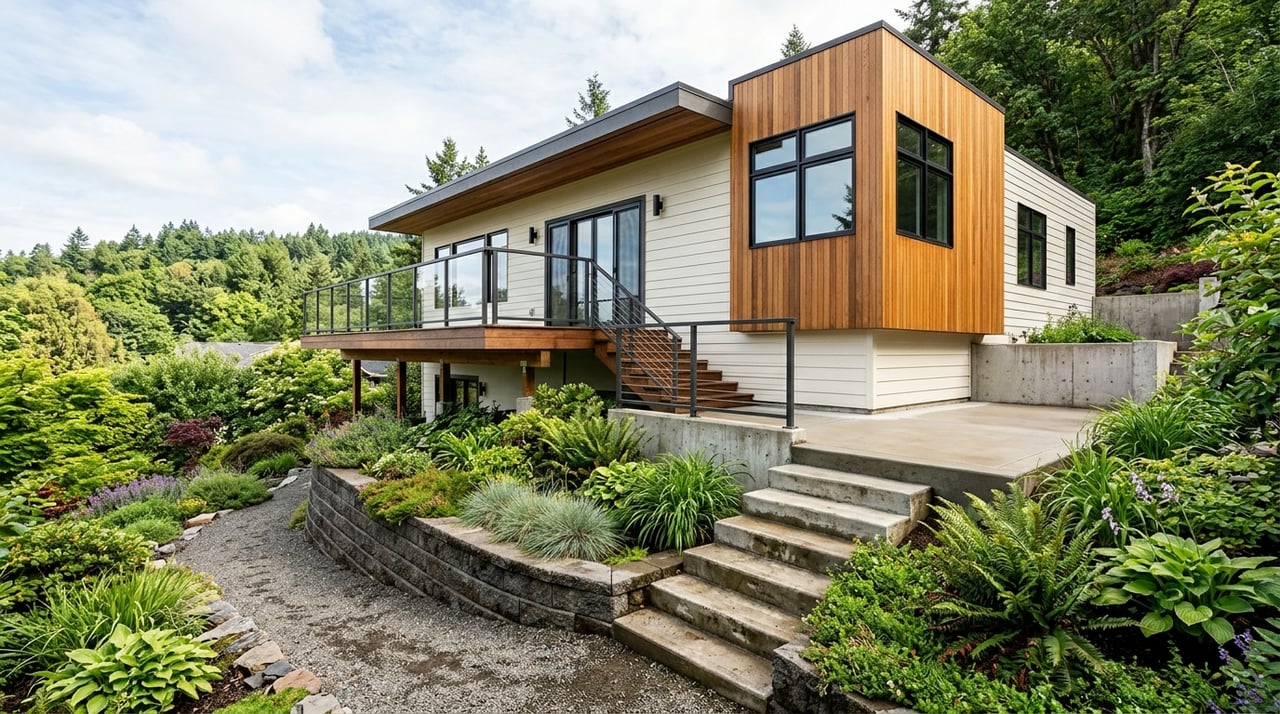
In practical terms, that can mean more custom-looking designs, larger windows, and floor plans that take advantage of views. You may also see homes that appear modest from the street but open up dramatically on the downhill side.
Northwest Regional and Early Modern Influence
This area also has an important modernist design lineage. The West Hills includes homes influenced by the Northwest Regional style and early modern design, with features like strong connections to the landscape, steep-hillside construction methods, and larger glazed openings that capture light and views.
For you as a buyer, that means the broader Forest Park area can include older traditional homes, early modern residences, and later contemporary hillside homes all within a fairly close radius. It is a market where architectural variety is part of the appeal.
How Lot Types Shape Daily Living
Irregular and Wedge-Shaped Lots
In the West Hills, residential lots are often moderate in size but not perfectly rectangular. Many are wedge-shaped or irregular, and building placement can vary based on the slope.
That affects more than just the survey. It can change where the driveway sits, how much yard is actually usable, where outdoor living areas fit best, and how private the home feels from neighbors or the street.
Downhill Lots
On downhill lots, homes are often built closer to the street with minimal front setbacks. Because the land falls away behind the house, the backyard may be smaller, steeper, or less usable as a flat lawn.
That does not automatically mean less outdoor enjoyment. In many cases, these homes lean into decks, terraces, and view-oriented spaces instead of traditional backyards.
Uphill Lots
On uphill lots, the house may sit higher and farther back from the street. That can create a different arrival experience and sometimes a stronger sense of separation from the road.
The tradeoff is that access, stairs, and driveway design may matter more. A home on an uphill site can feel private and elevated, but it may also ask more from you in terms of navigation and maintenance.
More Regular Lots Below the Steeper Hillsides
Below the steeper hillside sections, lot patterns can become more regular. In these areas, you may see a more predictable grid and lot widths that feel easier to compare from one home to the next.
This kind of lot can be appealing if you want a more conventional yard layout or a home that behaves more like a typical in-town property. Even so, it is still important to verify the specific site dimensions and topography before making assumptions from photos alone.
Narrow Lots and Flag Lots
Some listings may mention narrow lots or flag lots. Portland defines a flag lot as a parcel with a narrow access strip leading to a buildable site behind another lot.
These can offer a different privacy setup, but access and parking layout deserve a closer look. If a property uses this type of lot configuration, it is smart to evaluate how the driveway, entry sequence, and daily convenience will work for your household.
Privacy, Trees, and Outdoor Space
Why Homes Can Feel More Private
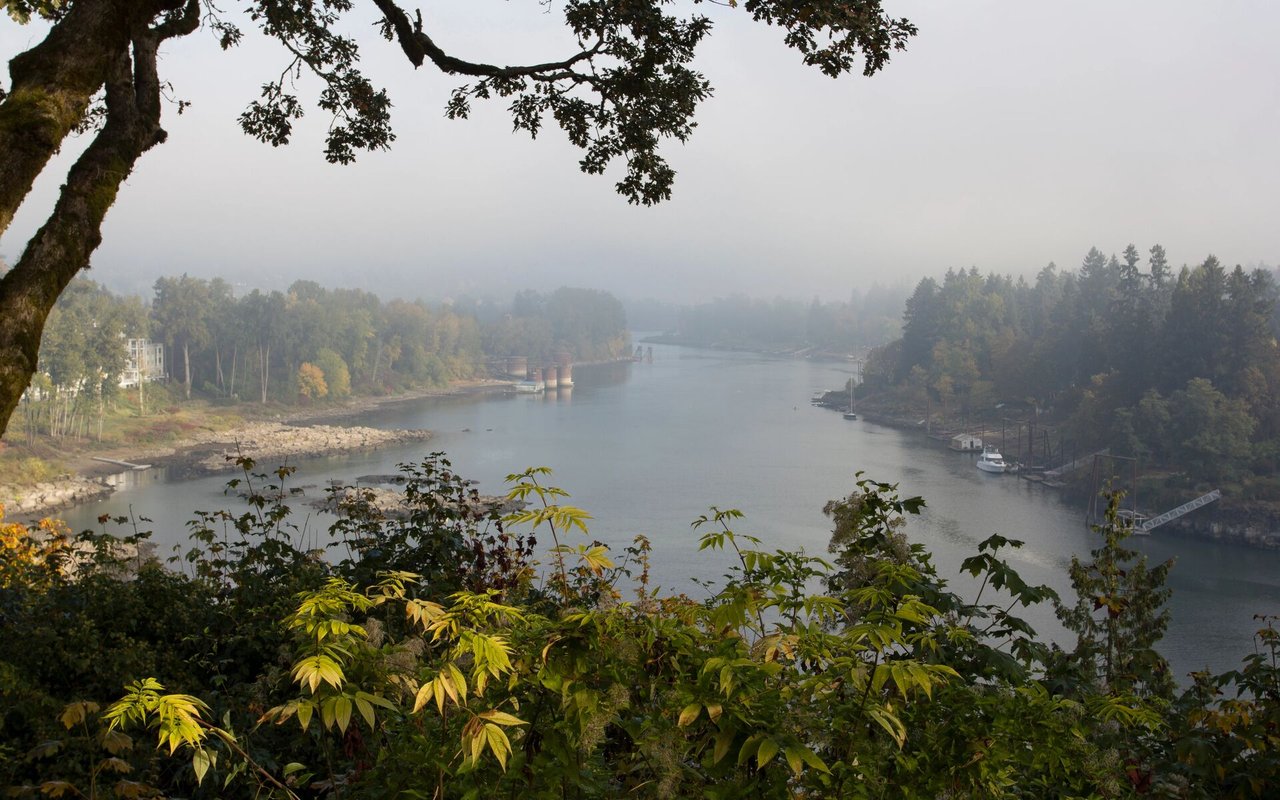
One of the clear draws in this market is the wooded setting. Larger setbacks in some hillside areas and mature fir trees can create a greener and more private feel than denser inner-city blocks.
That sense of privacy is real, but it often comes with site-specific tradeoffs. Trees, slope, and setbacks may create a calm setting while also limiting flat outdoor space or changing how much sun reaches the yard.
Outdoor Living Often Looks Different Here
If you picture a large flat backyard, you may need to adjust your expectations in some parts of the Forest Park area. On steeper sites, outdoor living is often organized around decks, side yards, terraces, and view-facing spaces rather than open lawn.
For many buyers, that works beautifully. The key is making sure the outdoor setup matches how you actually want to live, whether that means dining outside, gardening, room for pets, or simply low-maintenance space.
Maintenance and Access Matter More
Wooded hillside homes can also come with a different maintenance profile. Adjacent owners are responsible for keeping trees and plants from blocking visibility, and sidewalk damage caused by street trees may also require attention.
Access is another practical point. In the Forest Heights, West Hills, and Forest Park area, steep hillsides and limited hydrants create unique conditions, and winter snow or ice can affect travel more quickly than in flatter neighborhoods.
How to Read Listings More Accurately
Focus on the Subarea
When you see a listing marketed as being near Forest Park, start by confirming the exact location. Official city references distinguish Forest Park, Northwest Heights, and Forest Heights-related locations, so the best comparison is usually the specific street and neighborhood pocket, not the broad headline.
This matters because the experience of one block can differ sharply from the next. A traditional house on a more regular lot and a contemporary home on a steep site may both carry a Forest Park-area label, but they offer different day-to-day lifestyles.
Separate House Style From Site Type
One of the best habits in this market is to evaluate the home and the lot as two separate things. A beautiful house plan can feel very different depending on whether it sits on a steep downhill lot, an uphill lot, or a more regular street lot.
That simple shift can help you avoid overvaluing square footage while missing what matters most in daily life. Yard usability, parking layout, privacy, and maintenance needs often come from the site first.
Check Maps and Topography Early
Before you get too attached to listing photos, review the property’s lot dimensions, contours, zoning, and topography through PortlandMaps and the city’s zoning maps. Those details can help you understand whether the driveway, view corridor, and outdoor space shown online match the real-world site.
This step is especially helpful in hillside areas where photos may not fully show grade changes. A careful review early on can save time and lead to better side-by-side comparisons.
What This Means for Buyers and Sellers
If you are buying, the main takeaway is simple: in the Forest Park area, the lot is not a side detail. Topography shapes the home’s form, the way outdoor space works, the level of privacy, and the likely maintenance burden.
If you are selling, that same reality creates an opportunity. Clear positioning around site benefits, architectural style, access, and outdoor function can help buyers understand what makes your property distinct within the broader 97229 market.
In a part of Portland where no two blocks feel exactly alike, local interpretation matters. Understanding the street, the slope, and the lot type is often the difference between a good match and a great one.
If you want clear guidance on how a specific West Hills or 97229 property fits the market, ELEETE Real Estate offers the kind of neighborhood-level insight that helps you compare homes strategically and market them effectively. To start the conversation, visit Lee Davies - Main Site.
FAQs
What home styles are common near Portland’s Forest Park area?
- In the broader 97229 West Hills market, you may see traditional detached houses on flatter streets, contemporary hillside homes designed around slope and views, and some homes influenced by Northwest Regional or early modern design.
What lot types are common in the Forest Park and West Hills area?
- Lots in this area are often moderate in size and may be irregular, wedge-shaped, uphill, downhill, narrow, or configured as flag lots, depending on the street and topography.
Why do two Forest Park-area homes with similar size feel so different?
- In this market, slope and lot layout often affect privacy, usable yard space, entry access, parking, and outdoor living, so similar square footage can translate to very different daily experiences.
What should you check before buying a home near Forest Park in 97229?
- You should verify the exact subarea, review lot dimensions and topography, and look closely at how the slope affects the driveway, outdoor space, privacy, and maintenance needs.
Do homes near Forest Park usually have large flat backyards?
- Not always. On steeper hillside lots, outdoor space is often arranged as decks, terraces, or side yards rather than a traditional flat backyard lawn.
Why is the exact neighborhood label important in the Forest Park area?
- Listing language can span nearby pockets such as Forest Park, Forest Heights, and Northwest Heights, so the most useful comparison is usually the exact street, slope, and neighborhood pocket rather than the broader marketing label.